



Two Unprofitable Tech Stocks, Two Very Different Risk Profiles
Picking between early-stage technology stocks often comes down to one question: what does the company already have versus what is it still trying to prove? BigBear.ai and QuantumScape sit on opposite ends of that spectrum. Both are unprofitable. Both are early-stage. But one has paying customers locked into contracts that are notoriously hard to exit, and the other is still working to demonstrate that its core technology can survive the jump from lab to factory floor.
That distinction matters more than almost any other factor when sizing up either stock heading into 2026.
BigBear.ai operates in artificial intelligence and data analytics, selling primarily to U.S. government agencies. QuantumScape is a battery technology company backed by Volkswagen, pursuing solid-state lithium-metal batteries as a replacement for the conventional lithium-ion chemistry that currently powers electric vehicles. The companies share almost nothing in common except their early-stage status and their absence of profits – which makes comparing them useful precisely because it forces investors to get specific about what kind of risk they are actually accepting.

BigBear.ai’s Government Relationships Are the Whole Argument
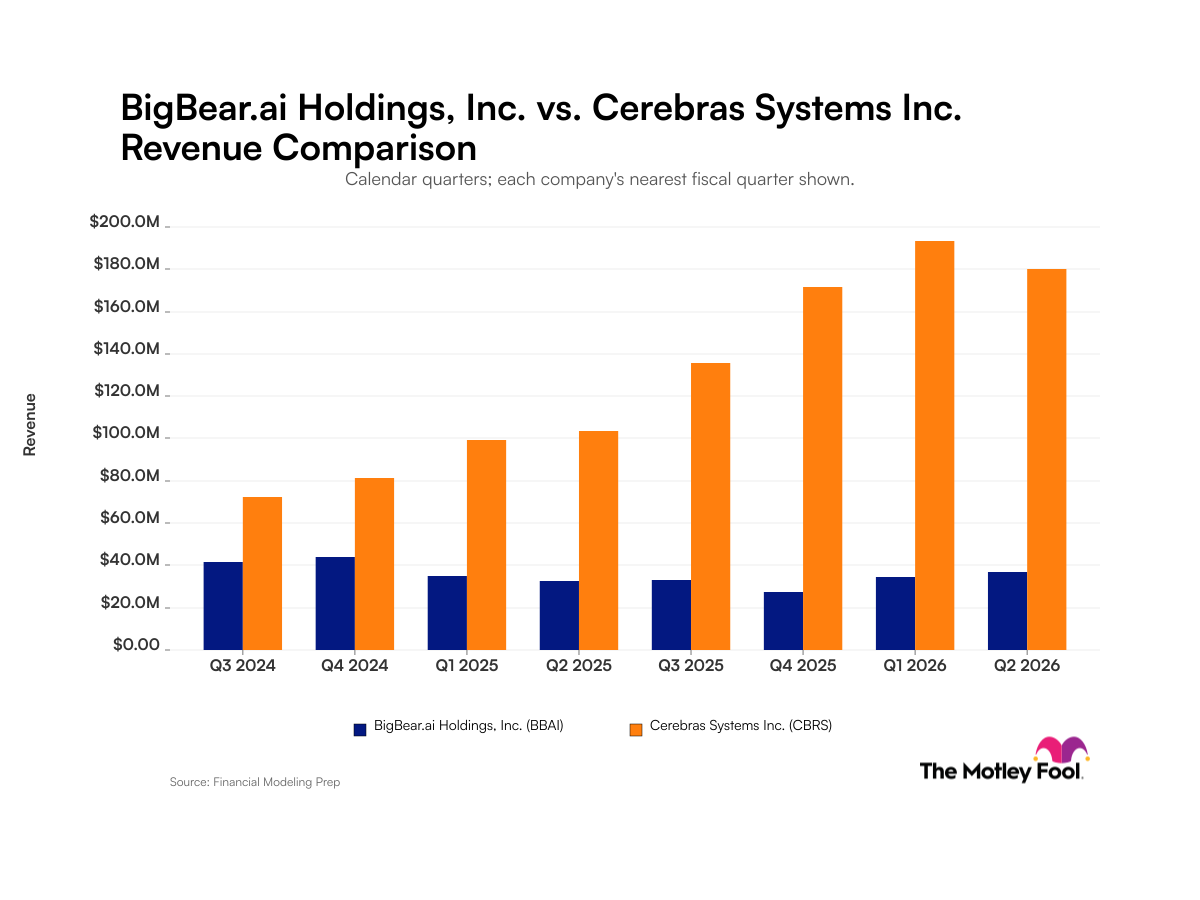
The single strongest thing BigBear.ai has going for it is customer stickiness. Government contracts, particularly in defense and intelligence, are not like commercial software subscriptions. Agencies build workflows around vendors, integrate systems over years, and face enormous bureaucratic friction when switching. Once BigBear.ai’s analytics tools are embedded in an agency’s operations, displacing them requires a procurement process that can take longer than the original contract cycle. That’s not a marketing claim – it’s how government technology spending works structurally.
This doesn’t make BigBear.ai a safe investment. It makes the revenue base more defensible than it would be in a competitive commercial market. For an unprofitable company, that difference is significant. A startup losing money while serving customers who are difficult to displace is in a fundamentally different position than one losing money in a market where customers can leave next quarter. BigBear.ai’s path to profitability, while not guaranteed, runs through deepening those existing government relationships rather than winning entirely new ones from scratch – which is a more achievable near-term task. AI revenue growth stories across the tech sector are accelerating in 2025 and 2026, and government-facing AI vendors are positioned to capture a slice of that spending as federal agencies modernize.
Still, government dependence is also a concentration risk. Budget cycles, continuing resolutions, and shifting political priorities can delay or reduce contract values without warning. A company whose revenue depends heavily on a single category of customer has limited ability to offset those disruptions by pivoting to other verticals quickly. BigBear.ai’s stickiness and its vulnerability come from the same source.
QuantumScape Is Betting Everything on a Technology That Doesn’t Yet Exist at Scale
QuantumScape’s proposition is genuinely ambitious. Solid-state batteries, if they work at commercial scale, would offer higher energy density, faster charging, and better safety profiles than today’s lithium-ion cells. The company has backing from Volkswagen, which gives it credibility and a potential first customer. Its early laboratory results have drawn serious attention from the scientific and investment communities.
The problem is the gap between laboratory performance and manufacturing reality. Battery chemistry that works in controlled conditions at small volumes has repeatedly failed to translate into cells that can be produced consistently, affordably, and at the volumes an automaker needs. QuantumScape is still in the process of proving its technology can cross that gap. It has not demonstrated commercial-scale production. Every dollar it spends is going toward a question – can this actually work outside a lab? – that remains unanswered. That is not a knock on the science. It is an accurate description of where the company stands.
For investors, this means QuantumScape’s value is almost entirely speculative. It rests on the probability that the technology will eventually be proven viable, that QuantumScape will be the company to prove it, that it will secure the manufacturing partnerships needed to scale, and that the electric vehicle market will remain large enough to absorb the output once they get there. Each of those steps is uncertain individually. All of them being true simultaneously is the bet the stock requires you to make. That’s a very long chain of contingencies for an unprofitable company with no commercial revenue to speak of.
Unprofitability Is Not Equal Across Both Companies
Both companies losing money is the starting point of any comparison, not the conclusion. The nature of the losses is what differentiates them. BigBear.ai is losing money while operating a real business – it has customers, it delivers services, it generates revenue, and its losses reflect the cost of growth and investment in a company that is functioning commercially. QuantumScape is losing money while still trying to validate whether it has a business at all. Its losses are pre-commercial in a deeper sense: the spending is going toward answering fundamental technical questions, not toward scaling something that already works.
This distinction has direct implications for downside risk. If BigBear.ai underperforms, the most likely outcome is slower growth or continued unprofitability, not total failure – the government customers aren’t going away overnight. If QuantumScape’s core technology fails to prove out at commercial scale, the company’s entire premise collapses. There is no fallback product line, no alternative revenue stream to point to. The floor on QuantumScape’s downside is lower, and the width of the range of possible outcomes is wider.

What Kind of Investor Actually Belongs in Either Stock
BigBear.ai suits investors who want early-stage AI exposure with at least some structural support beneath it. The government contract base provides a revenue floor that pure-play speculative tech stocks lack. The risk is real – unprofitability, concentration, and the competitive pressure that comes as larger defense contractors build out their own AI capabilities – but the risk has a shape investors can reason about. There are known variables and knowable milestones: contract renewals, revenue growth, margin trajectory.
QuantumScape is a different category of bet entirely. It belongs in a portfolio only for investors who can absorb a complete loss on the position and who believe, specifically, that solid-state battery technology will reach commercial viability and that QuantumScape will be among the companies that gets there first. That’s not an unreasonable belief – the technology has real scientific merit and the backing of a major automaker. But it is a belief, not a calculation. The investment thesis is essentially a call option on a technological outcome that hasn’t happened yet.
Neither stock is appropriate for investors who need capital preservation or who are uncomfortable holding a position through years of potential losses and no clear profitability timeline. The question between them isn’t which is safer – neither is safe – but which kind of uncertainty fits the portfolio and the investor’s tolerance for ambiguity.
QuantumScape’s Volkswagen backing means there’s a well-capitalized partner watching the technology develop in real time, and that partner’s continued involvement would be the clearest signal yet that commercial viability is within reach. Whether Volkswagen stays patient long enough is a separate question entirely.