


Same Philosophy, Different Bets
Berkshire Hathaway and an S&P 500 index fund share more DNA than most investors realize. Both are built on the same core premise: buy diversified stakes in American business, hold them for years, and let compounding do the work. For a long-term investor sitting down to choose between the two, that philosophical overlap can make the decision feel almost trivial – as if you’re just picking between two flavors of the same thing.
They are not the same thing. Beneath that shared buy-and-hold foundation sits one difference that matters considerably for the foreseeable future, and understanding it changes how you should weigh each option.

What You’re Actually Buying With Each
An S&P 500 index fund gives you a passive, market-weighted slice of 500 of the largest publicly traded U.S. companies. When Apple rises, your fund rises proportionally. When a struggling retailer gets dropped from the index, it disappears from your portfolio automatically. The whole structure is designed to remove human judgment from the equation – you own the market, full stop, and the market decides how capital gets allocated across those 500 names.
Berkshire Hathaway is something different in structure, even if it rhymes in spirit. Warren Buffett built it as a holding company that owns businesses outright – BNSF Railway, GEICO, Berkshire Hathaway Energy – alongside a massive equity portfolio that includes large positions in Apple, Coca-Cola, American Express, and Bank of America. That equity portfolio is itself a concentrated bet on a handful of companies, not a diversified index. The whole operation runs through Buffett’s judgment, and to a lesser extent, his two investment deputies, Ted Weschler and Todd Combs.
The One Difference That Drives the Decision
That word – judgment – is where the fork in the road appears. An index fund has none. It mechanically tracks whatever the market values, buying high-priced stocks because they’re large and selling fallen ones because they’ve shrunk. Berkshire, by contrast, is structured to act when others won’t. Buffett has deployed tens of billions of dollars during market dislocations that sent index fund investors scrambling – and he has done it with capital that Berkshire’s insurance businesses generate continuously in the form of float.
Float is one of Berkshire’s structural advantages that often gets underappreciated in casual comparisons. Insurance premiums come in before claims go out, leaving a pool of investable cash that Berkshire gets to deploy in the interim. At its current scale, that float runs into the hundreds of billions of dollars. An index fund investor has no equivalent mechanism – they invest what they contribute, and that’s it.
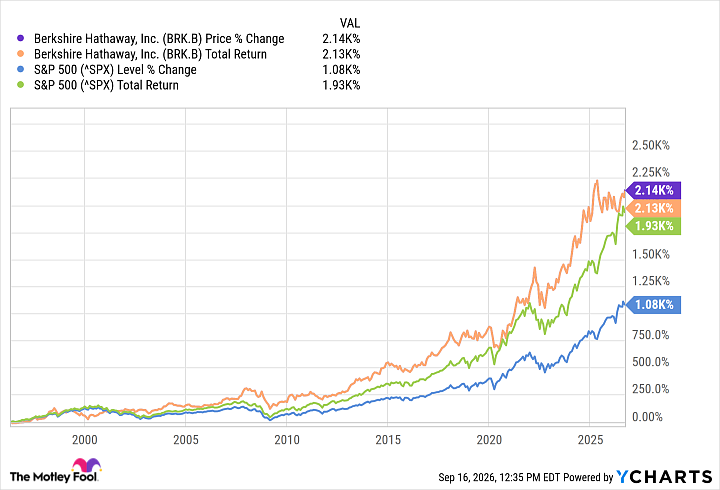
Where this divergence becomes most consequential is in Berkshire’s enormous cash reserve. At last count, the company was sitting on well over $300 billion in cash and short-term Treasury holdings – a position so large it became a recurring topic at the 2024 annual shareholder meeting. Buffett has been candid about why: he hasn’t found businesses or stocks at prices he considers attractive enough to deploy that capital. That’s a meaningful constraint for shareholders expecting Berkshire to compound aggressively. Cash earns less than a productive operating business over time.
For an index fund investor, that cash drag doesn’t exist. The fund is always fully invested in equities. During a strong bull market, that structure wins. Every dollar is working at market returns rather than sitting in Treasuries. The S&P 500’s performance over the last decade-plus, during a period of low interest rates and rising valuations, rewarded full equity exposure richly – and index funds captured every basis point of it.
What Buffett’s Cash Position Is Actually Saying
Buffett’s reluctance to deploy that $300 billion-plus isn’t just a cash management quirk. It’s an implicit statement about valuations. When one of history’s most successful investors declines to buy stocks at scale, it’s worth asking whether the market is priced to deliver the returns most investors are counting on. That’s not a prediction – it’s a tension built into the current comparison between these two investment vehicles.
An index fund buyer today is, in effect, saying they’re comfortable paying whatever price the market has set for those 500 companies. Berkshire’s cash hoard suggests Buffett is not.

Which One Makes More Sense Right Now
For most individual investors – particularly those who don’t actively monitor markets and aren’t making regular decisions about when to buy or sell – the S&P 500 index fund remains a structurally sound choice. Low fees, broad diversification, and full equity exposure have compounded wealth reliably over multi-decade periods. The data on active management underperforming passive indexing over time is extensive, and Berkshire, whatever its advantages, is still an actively managed vehicle.
Berkshire’s appeal, by contrast, is more specific. It is better suited to investors who want the potential for outperformance during market disruptions, who value downside protection from cash and insurance-backed operations, and who are comfortable accepting the risk that comes with concentration in a single stock. Berkshire is one company – it can be sued, mismanaged, or caught in an industry-specific crisis in ways that the S&P 500, by design, cannot be.
The succession question adds another layer. Buffett, now in his mid-90s, has named Greg Abel as his designated successor to lead Berkshire after he steps back. Abel is widely respected inside the company, but Buffett’s capital allocation instincts are not a manual that can be handed over with a title. The ability to recognize when to hold $300 billion in cash and when to deploy it rapidly – the very skill that defines Berkshire’s edge over a passive index – is exactly what investors will be watching Abel prove out, possibly soon.