


Two AI Suppliers, Two Very Different Revenue Stories
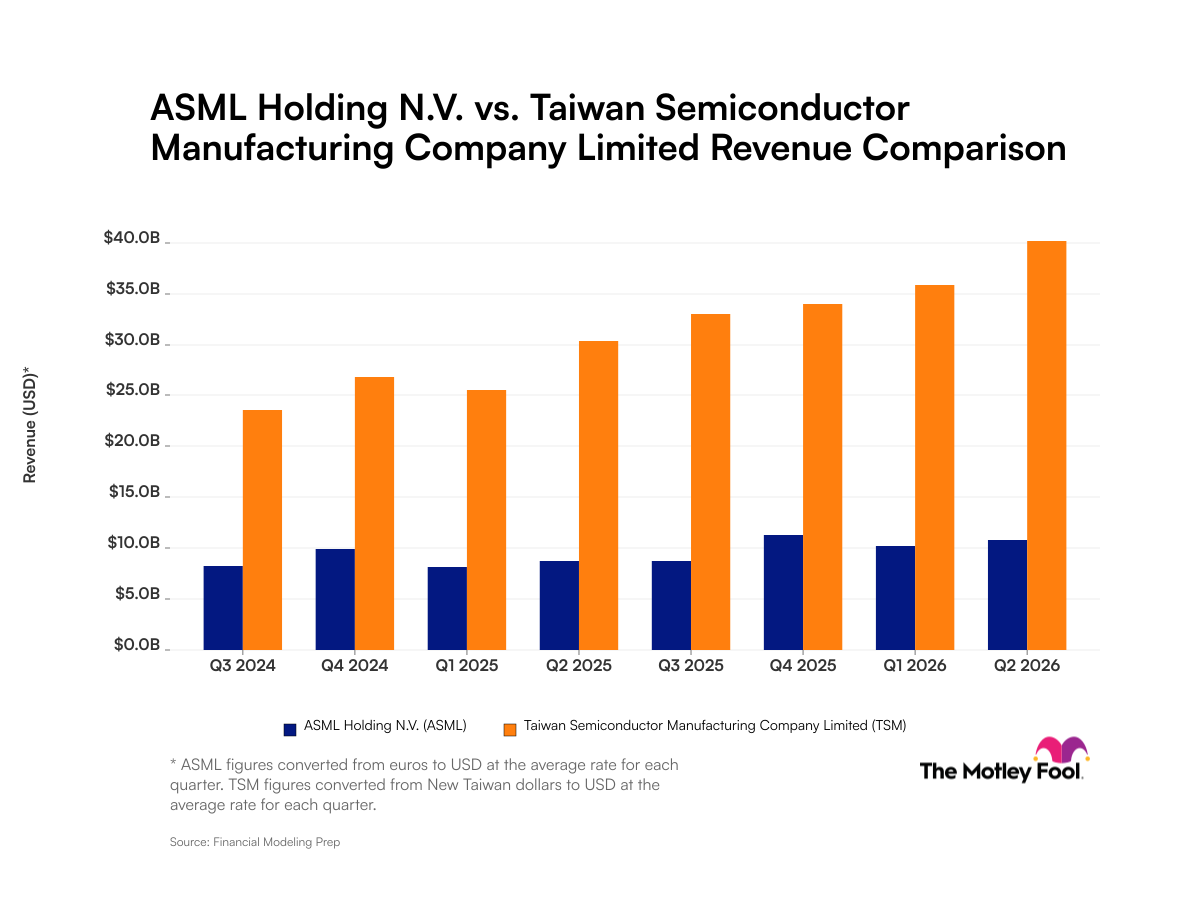
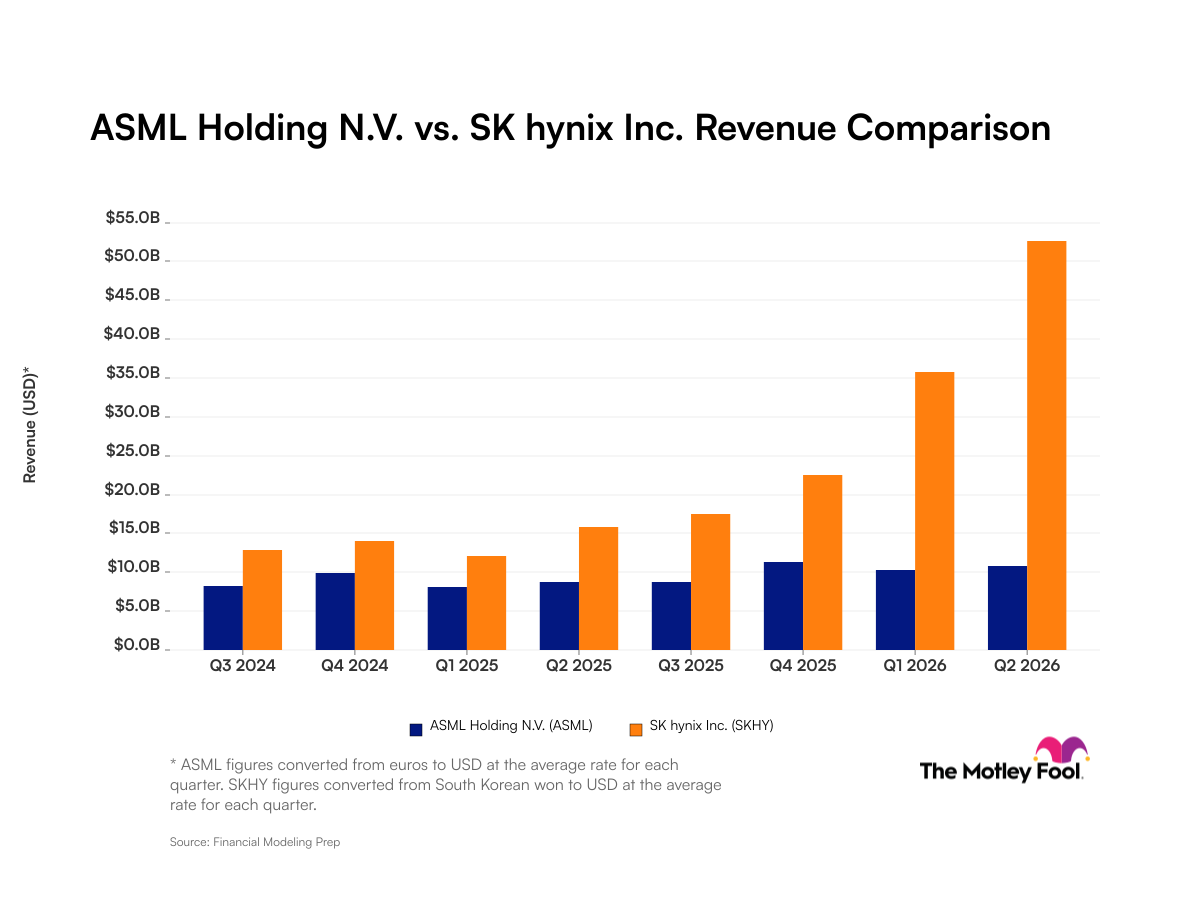
Taiwan Semiconductor Manufacturing Company has generated more revenue than ASML in every single quarter across the last eight reported periods – and the gap between them, in absolute dollar terms, has been substantial. TSMC manufactures the chips that power everything from data center AI workloads to consumer smartphones, making it one of the highest-volume businesses in the semiconductor industry. ASML, by contrast, sells the lithography machines that chipmakers like TSMC need to build their fabs. The customer base is narrower, the sales cycles are longer, and the numbers have historically reflected that.
But something has shifted in ASML’s recent quarterly data. Revenue growth at the Dutch equipment maker has started accelerating in a way that has not gone unnoticed by investors tracking AI-linked semiconductor plays. The question is whether that acceleration represents a durable change in demand or a temporary surge driven by backlog timing.
What the Eight-Quarter Trend Actually Shows
Looking at eight consecutive quarters of revenue data for both companies, TSMC’s dominance in absolute revenue is not close. The Taiwanese chipmaker operates fabs around the clock, producing wafers for Apple, Nvidia, AMD, and dozens of other fabless designers. That volume produces revenue at a scale ASML structurally cannot match – ASML sells machines, not chips, and there are only a handful of customers globally capable of buying and operating extreme ultraviolet lithography equipment.
ASML’s business model means its revenue is choppier by nature. A single EUV system can cost well north of $100 million, so quarterly figures swing based on how many units ship in a given period and when customers take delivery. That lumpy cadence has historically made ASML look like the smaller, slower-growing of the two AI infrastructure stories – even though the company holds a monopoly on the most advanced lithography technology available anywhere in the world.
Over the eight quarters in question, TSMC has also posted strong growth of its own, driven by surging demand for advanced node chips used in AI training and inference hardware. Nvidia’s H100 and subsequent accelerator chips are all manufactured on TSMC processes. Every GPU cluster a hyperscaler installs represents TSMC wafer revenue. That structural link to AI spending has kept TSMC’s growth elevated even as the broader consumer electronics market remained soft for much of 2023 and into 2024.
ASML’s Acceleration and What’s Behind It
ASML’s recent quarters show a growth rate moving in the opposite direction from what investors had grown accustomed to seeing. After a period where order intake disappointed and the company itself guided conservatively, bookings and revenue have started trending upward with more conviction. The driver is not complicated: chipmakers are committing capital to build the next generation of advanced fabs, and those fabs require EUV tools that only ASML can supply.
TSMC’s own capital expenditure plans are part of that picture. The company has committed to massive fab investments in Arizona, Japan, and continued expansion in Taiwan – each of those facilities requires lithography equipment, and the leading-edge nodes require EUV specifically. When TSMC spends, ASML benefits. The relationship between the two companies is less competitive than it is symbiotic, which is part of what makes comparing their revenue trends useful for investors trying to understand where value is being created across the AI hardware supply chain.
Different Roles, Different Risk Profiles
Investors often frame ASML and TSMC as interchangeable AI picks, but the risk profiles diverge sharply once you look past the shared exposure to semiconductor demand. TSMC carries geopolitical risk that is difficult to quantify – its primary manufacturing base sits 110 miles from mainland China, and any escalation in the Taiwan Strait would immediately disrupt global chip supply. ASML, headquartered in Eindhoven, Netherlands, faces a different set of political pressures: export restrictions have already blocked the company from shipping its most advanced systems to Chinese customers, which removes a significant potential revenue stream.
Neither risk is trivial. But the nature of each company’s exposure is different enough that investors treating them as equivalent bets on AI infrastructure are likely underweighting the geographic and regulatory dimensions of the trade. ASML’s export controls are a known constraint on its total addressable market. TSMC’s Taiwan concentration is a tail risk that hasn’t materialized – but that the market periodically reprices without warning.
On the growth side, ASML’s monopoly position in EUV gives it pricing power that few industrial companies anywhere can claim. When Intel, TSMC, and Samsung all need the same machine to stay competitive, and only one company makes that machine, the seller sets the terms. That dynamic does not show up clearly in an eight-quarter revenue comparison against TSMC, where the absolute numbers will almost certainly continue favoring the chipmaker. But margin trajectory and order backlog tell a more nuanced story about where ASML sits in the value chain.
TSMC’s revenue base is larger, and it will likely stay larger for the foreseeable future given the sheer volume of chips the company produces. But volume and growth rate are different metrics. A company can have enormous revenue and decelerating growth at the same time, just as a smaller company can post modest absolute numbers while its growth rate climbs. The eight-quarter comparison between ASML and TSMC is most useful not as a verdict on which company is “better,” but as a baseline for understanding how capital is flowing through the AI semiconductor stack – and which layer of that stack is accelerating fastest right now.
Reading the Revenue Gap as a Signal
For investors, the persistent revenue gap between TSMC and ASML across eight quarters is less interesting than the direction each company’s growth rate is moving. TSMC has already proven its scale. ASML’s recent acceleration raises a more specific question: if global fab investment continues ramping through 2025 and 2026, how many EUV systems can ASML actually manufacture and ship in a given year? The company has talked publicly about expanding its own production capacity, but tool manufacturing is not something you scale overnight. ASML’s output constraints could end up being the binding factor on how quickly the world’s chipmakers can build the next generation of AI-capable fabs – which would mean ASML’s revenue growth, however fast it gets, is still being throttled by its own supply limits rather than by customer demand.