


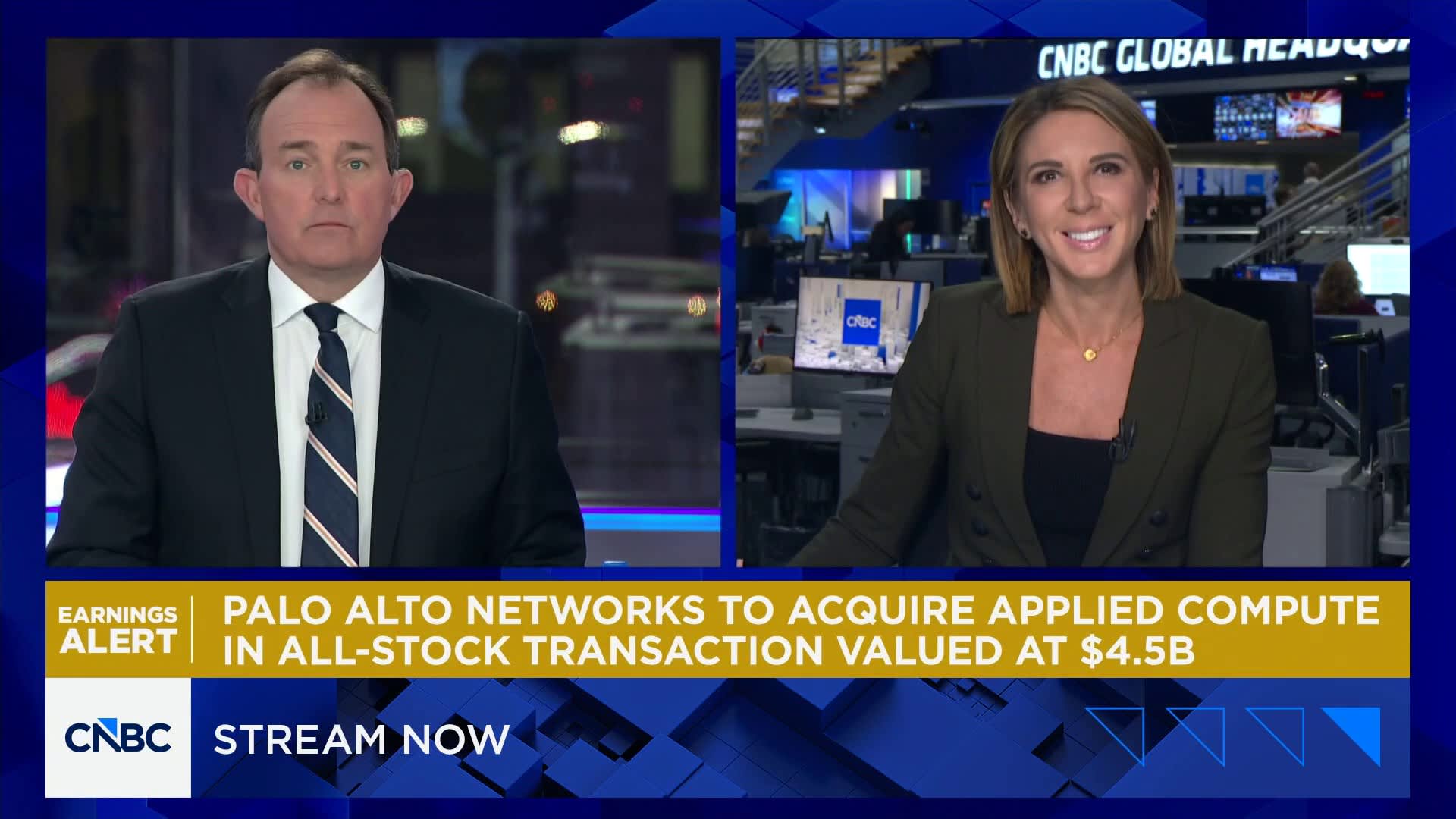
Palo Alto Networks beat Wall Street’s expectations for its fiscal first quarter, and investors bid the stock higher. The earnings were only half the news. The cybersecurity company also agreed to buy Applied Compute, an AI startup, in a deal valued at $4.5 billion.
The market’s reaction suggests investors are willing to accept a large acquisition alongside a clean quarter, at least for now. The deal is also a statement about where the company thinks its next security problem will come from: the open-weight AI models that businesses are starting to run inside their own walls.
A Clean Quarter, Then a Large Check
Beating estimates in a first quarter sets a tone for the fiscal year. It gives management room to talk about strategy rather than defend its numbers, and that matters when the same call includes a multibillion-dollar acquisition. A company that had missed would have faced sharper questions about whether it was spending money it needed elsewhere.
Palo Alto got the opposite setup. The results cleared the bar, the stock rose, and the Applied Compute announcement landed on a day when sentiment was already favorable. The price is the part worth sitting with. At $4.5 billion, this is a purchase large enough that the company is plainly treating it as a core product bet and not a tuck-in.
Why Open-Weight Models Are a Security Problem
An open-weight model is one whose trained parameters are published for anyone to download. A company can take those weights, host them on its own servers, adjust them with its own data, and never send a prompt to an outside provider. That appeals to banks, hospitals, government contractors, and anyone else who would rather keep sensitive information off someone else’s infrastructure.
The same freedom creates a gap. When a company calls a closed model through a vendor’s interface, the vendor owns most of the safety work. When a company downloads weights and runs them itself, that work shifts to the customer. Nobody inside the customer’s security team may have ever been asked to vet a file containing billions of numbers.
The risks are concrete. A set of weights could have been tampered with before download. A fine-tuned version pulled from a public repository might behave normally in testing and misbehave on specific triggers. A model deployed internally might leak data it was trained on, or follow instructions hidden in a document it was asked to summarize. Traditional security tools were built to inspect code, network traffic, and endpoints, and a model file fits none of those categories neatly.
That is the opening Palo Alto appears to be targeting. The framing around the deal is about securing open-weight models, which means the company is betting that enterprises will adopt them in volume and that someone has to certify, monitor, and defend them. Whoever owns that layer sits in the path of every deployment, much as firewalls sat in the path of every network connection a generation ago.
What Palo Alto Is Really Buying
Acquisitions in security often come down to a choice between building and buying. Building takes years and requires hiring scarce talent. Buying gets a team and a working product immediately, at a premium. A $4.5 billion price says Palo Alto decided speed was worth a great deal, and that waiting while competitors assembled their own AI-security stacks carried a higher cost.
The deal terms beyond the headline price were not part of the information available for this report, so questions about structure, timing of close, and how the startup will be folded into existing products remain open. Those details will shape how quickly the purchase shows up in revenue. An acquisition of this size usually takes several quarters to produce visible results, and integration is where many security deals lose momentum.
The Test Ahead
For the stock, the immediate verdict is positive. Investors saw a company that delivered a better-than-expected quarter and then explained how it plans to stay relevant as corporate AI moves from experiments to production systems. That is a stronger position than announcing a large deal into a weak report.
The harder test comes later. Palo Alto has to show that customers will pay for model security as a distinct purchase rather than expecting it bundled into platforms they already own. It also has to show that the threat is real enough, and frequent enough, to justify a budget line.
Every large security acquisition carries a similar promise: the threat is coming, and we bought the answer early. Sometimes the threat arrives on schedule and the early mover wins. Sometimes it arrives slowly, and the premium paid for being early looks expensive for years.
Palo Alto has now put $4.5 billion behind the first outcome. If enterprises keep moving toward models they host themselves, the purchase may look prescient. If most of them stay with closed models managed by a vendor, who exactly will be buying the protection?