



Tesla’s Model 3 didn’t just save the company – it rewrote what was possible for an electric vehicle startup turning production ambitions into actual profit. Rivian is now tracing a path that looks, at least in outline, remarkably similar.

What Tesla’s Breakthrough Actually Looked Like
The numbers from Tesla’s Model 3 era are worth sitting with. Following the production breakthrough tied to that vehicle, Tesla’s stock climbed 1,364% over three years. That’s not a gradual grind higher – that’s the kind of move that redefines a company’s standing in financial markets and turns early believers into generational investors.
What made the Model 3 inflection point so significant wasn’t just sales volume. It was the moment Tesla proved it could manufacture at scale without bleeding cash on every unit. Before that, the company was perpetually burning through capital, surviving on investor faith and occasional equity raises. After it, Tesla became a business with real operating leverage – one where each additional car sold contributed meaningfully to the bottom line rather than deepening the hole.
Production breakthroughs in the auto industry are rare and tend to arrive unevenly. A company can spend years burning money on tooling, logistics, and workforce before the pieces align. When they do, the financial profile changes fast – margins expand, cash flow improves, and the narrative around the stock shifts from survival to growth.
Tesla’s 1,364% stock run over three years was the market pricing in that shift in real time. Investors who recognized the inflection early captured most of those gains. Those who waited for confirmation often paid much higher prices for a much smaller slice of the upside.
Where Rivian Stands – and Why the Comparison Holds
Rivian is a young company by any measure, still working through the early and painful chapters that every capital-intensive manufacturer must survive. It has vehicles on the road – the R1T pickup, the R1S SUV, and a commercial delivery van built in partnership with Amazon – but the financial story has remained one of high spending against still-developing revenue. That’s the setup, not the destination.
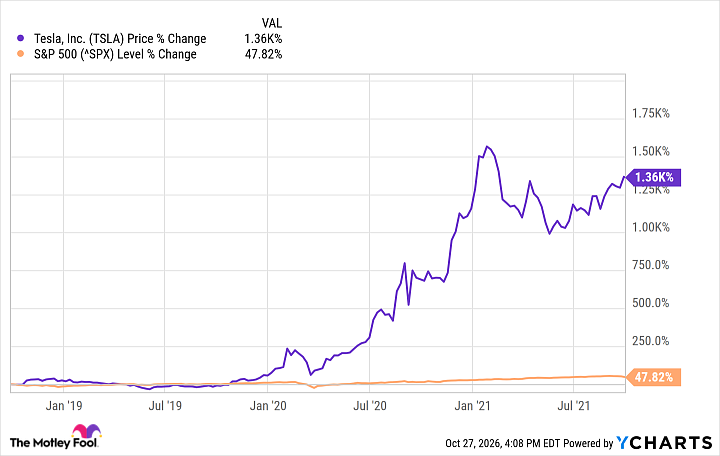
The argument forming around Rivian is that it may be approaching its own version of the Model 3 moment – the point where production efficiency catches up to production ambition. That kind of transition doesn’t announce itself cleanly. It shows up first in unit economics, then in gross margin improvements, then eventually in cash flow. By the time it’s obvious to everyone, the stock has usually already moved.
Rivian’s situation carries its own specific pressures. Manufacturing a truck or SUV is more complex and more expensive than manufacturing a sedan. The company’s Georgia plant, which is expected to produce its more affordable R2 model, represents a significant bet that it can bring costs down enough to reach a broader market. The R2 is designed to be a higher-volume, lower-price-point vehicle – which is precisely the profile the Model 3 held for Tesla.
That parallel is not incidental. Tesla’s growth didn’t come from selling expensive Model S sedans to wealthy early adopters. It came from making a car that a wider slice of the market could actually afford. Rivian’s executive team has been explicit about the R2 serving a similar function – an entry into mainstream volume that its current lineup can’t reach on price alone.
Still, drawing lines between two companies’ trajectories is easier than living through them. Tesla had its own near-death moments during the Model 3 ramp. Elon Musk famously described the company as being weeks from bankruptcy at points during that period. Rivian is operating in a more competitive environment now, with legacy automakers and other EV startups all chasing the same customers. The window for capturing market share is real, but so is the competition crowding into it. For investors weighing volatile growth stocks, the cost of panic selling during a difficult stretch can be just as damaging as picking the wrong company.
The Investment Question Underneath the Analogy
Comparing Rivian to early Tesla is the kind of framing that sounds exciting and demands skepticism in equal measure. Tesla’s 1,364% rise over three years was an outcome, not a template. It required a specific set of conditions – a product that resonated, manufacturing that eventually worked, a CEO who commanded relentless market attention, and a broader EV adoption wave that was still accelerating. Rivian can control some of those variables and none of the others.

What Rivian’s potential Model 3 moment would actually require is a sustained improvement in production efficiency – lower costs per vehicle, better gross margins, and evidence that the company can scale without proportionally scaling its cash burn. If those numbers start appearing in quarterly reports, the conversation around the stock will shift. Whether that shift produces anything close to Tesla’s three-year, 1,364% run depends on factors that no comparison to history can reliably predict. The R2’s launch timeline, its actual production costs once manufacturing begins, and the state of EV demand in the years ahead will matter far more than any analogy drawn from Tesla’s past.