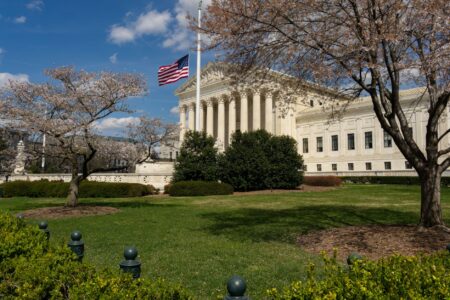



The nation’s highest court has opened the door for Alabama to eliminate one of its two congressional districts with majority Black populations ahead of the upcoming midterm elections.
Legal Framework Sets New Precedent
The Supreme Court’s decision represents a significant shift in how voting rights cases proceed through federal courts. Alabama had been operating under a lower court order that required the state to maintain two districts where Black voters comprised a majority of eligible voters. This arrangement stemmed from litigation challenging the state’s redistricting process following the 2020 census.
The ruling affects districts that have been economically and politically influential in Alabama’s congressional delegation. These areas include parts of Birmingham, Montgomery, and Mobile – regions that collectively represent billions in economic activity and federal funding allocations. The districts have historically sent Democratic representatives to Congress, creating a notable political minority within Alabama’s otherwise Republican-dominated delegation.
Federal courts had previously determined that Alabama’s initial redistricting plans violated the Voting Rights Act by diluting Black voting power. The state argued that maintaining two majority-Black districts created an unfair constraint on their redistricting authority and imposed artificial demographic requirements that didn’t reflect natural community boundaries.
Legal experts note that the Supreme Court’s intervention signals a broader reevaluation of how federal voting rights protections interact with state redistricting authority. The decision could influence similar cases pending in other states where minority voting rights advocates have challenged new district maps drawn after the latest census data.
Economic Impact Across Multiple Sectors
The districts in question encompass some of Alabama’s most economically diverse areas, including major manufacturing centers, agricultural regions, and urban commercial hubs. District boundaries directly affect how federal resources flow to these communities, influencing everything from infrastructure spending to small business development programs. Changes to these districts could alter the political representation for areas that collectively generate substantial portions of the state’s economic output.
Birmingham’s metropolitan area, partially contained within one of the affected districts, serves as a regional financial center with major banking operations and healthcare systems. The city’s economy has transitioned from its steel industry roots toward more diversified sectors including biotechnology, finance, and logistics. Political representation from this district has historically advocated for federal investments in these emerging industries.
Montgomery, the state capital, brings additional economic complexity through its role as both a government center and military hub. Maxwell Air Force Base contributes significantly to the local economy, while state government operations provide stable employment for thousands of residents. The district’s representation has typically focused on securing federal defense contracts and maintaining military installations that support local economic stability.
Agricultural interests also factor prominently in the affected areas. Parts of Alabama’s Black Belt region, known for its fertile soil and historical significance, fall within these districts. Cotton, soybeans, and cattle operations in these areas depend on federal agricultural policies and subsidies that congressional representatives help shape and protect. The region’s farmers have increasingly diversified into specialty crops and organic production methods that require different types of federal support.
Manufacturing facilities throughout both districts employ thousands of workers in automotive, aerospace, and chemical production. Companies like Mercedes-Benz, Honda, and various aerospace contractors have significant operations in areas that could see their congressional representation change. These facilities often benefit from federal trade policies, workforce development programs, and infrastructure investments that their representatives help secure and maintain.

Redistricting Timeline and Implementation
Alabama now faces pressure to redraw its congressional map before candidate filing deadlines for the midterm elections. The state legislature must balance the Supreme Court’s decision with ongoing legal challenges and practical considerations about conducting elections under new district boundaries. Primary elections are scheduled for later this year, creating a compressed timeline for implementing any changes to district maps.
The redistricting process will likely consider population shifts revealed in the 2020 census, including migration patterns between urban and rural areas within the state. Economic development in certain regions has attracted new residents, while other areas have experienced population decline. These demographic changes affect not only political representation but also federal funding formulas that depend on accurate population counts.

State officials must now weigh multiple factors including legal compliance, political considerations, and practical implementation challenges. The decision could reshape Alabama’s congressional delegation for the next decade, affecting how the state’s economic interests are represented in federal policy discussions. Will the reconfigured districts maintain the same level of federal advocacy for Alabama’s diverse economic sectors, or will the changes create new political dynamics that alter the state’s influence in Washington?